- Your brain expands breaking out of your skull to overtake your head.
- You sprout additional eyes all around your head, you can see forward sideways up and down all at once in an unbroken sphere of vision.
- Your arms fractalize so that below your elbows look like cauliflowers. You can hold and manipulate multiple objects in each “hand”.
- Your body becomes a gelatinous protoplasm that struggles to maintain your former shape, particularly your legs.
- Your eyes become stalked and snail-like, you can bend the stalks independently of one another.
- Your eyes divide as if by mitosis filling you eye sockets with numerous smaller eyes almost like having compound eyes. A handful of thick eyelashes stick out from in between them.
- Your body is warped 4 dimensionally, parts of you phase in and out of this dimension as you move making parts of you appear to be floating.
- Your body is vitrified into polygonal shapes like a low poly video game character, your limbs will shatter into razor sharp blades if dealt bludgeoning damage.
- You grow a second smaller infant-like head with a large jawless mouth, it wails if not fed three meals a day.
- Your lower half is paralysed but you gain the ability to float a foot above the ground, and psychically move small objects with your mind.
- Holes appear in your body that lead to an inky black space filled with twinkling stars, you can stow objects inside yourself as if you were a bag of holding.
- Your meat twists inside out, the air stings like being dissolved in acid.
- Your mouth becomes cephalopodic, you crave delicious brains. The smarter the better.
- Your bones become cartilaginous, making your limbs like thick tentacles.
- Your skin, muscle and bones become transparent, revealing the organs within.
- Holes appear in your hollowed out body that make you whistle like a flute when in the wind. People who hear your whistling become drowsy.
- You sprout sucking lamprey like mouths along your shoulders that reach towards any nearby creatures with a heartbeat to suck their blood.
- Fat lipped mouths appear on your palms that whisper your every thought and chew at anything you use to gag them.
- Your body becomes porous like a sponge, you soak up any liquid you come into contact with, dispelling it if you are squeezed.
- Your tongue becomes long and prehensile but prevents you from closing your mouth making speech difficult. Stick your tongue out while speaking.
- Your nose hairs lengthen into cilia like projections that sweep scents into your grotesquely enlarged nostrils. You can track by smell better than a bloodhound.
- Your torso sprouts 2d4 repetitions making you look like a centipede thing.
- You sprout gills that run across your chest from your belly to your armpits, they must be moistened with salt water daily.
- Your arms and legs lengthen so that your forearms are longer than your spine.
- You sprout 1d4 extra jaws and mouth bellow your first.
- You gain an additional joint in your arms.
- You become radially symmetrical gaining 1d4 additional front sides, growing additional arms legs and faces.
- Your mouth and eyes go from horizontal to vertical.
- Your eyes recede into your head and your forehead becomes transparent like a Barreleye fish.
- Your body becomes grey dust that floats defiance of gravity retaining your form even when parts are removed from you, which is quite easy to do as you are made of dust.
- You sprout crystals that seem to be constantly melting but never decreasing in size, they are some impossible colour between cyan and magenta.
- Orifices on macaroni like protuberances grow to cover your face, they let you smell the future.
- You constantly sweat a black fluid with oily viscosity, that falls upwards in defiance of gravity.
- You gain another mouth within your mouth and a mouth within that mouth, they can shoot out like a xenomorph.
- the numbers of fingers on your hands quadruple, and your finger gain an additional joint.
- Your teeth become spiralled like stubby narwhal horns.
- Your face becomes disfigured as if twisted into a spiral.
- Objects can orbit your head like moons to a planet.
- Two dimensional flat vantablack shards float around your head on the coronal plane like a angular halo.
- Your head detaches from your neck and becomes a floating ruby polyhedron. your face appears on every face.
- You lose your nose and sprout a retractable stalk that can manifest illusions on its tip. It retracts into your nasal cavity when not in use.
- Trypophobia inducing orifices develop all over your body with retractable glowing stalks inside that shine like candles with pastel blue light.
- Your arms flatten into ribbon like tentacles and grow to triple their length.
- The front of your belly, legs and under your arms become covered in hook filled suckers that pulsate unnervingly.
- You develop a vertical mouth across your breast and your ribs transform into teeth for it. It chatters when you are hungry.
- Your throat grows a fly like a proboscis that sits snugly in your mouth. You vomit on your food and slurp up the dissolved mess whenever you eat.
- Your bones grow like coral and sprout from your body, they have a smooth mirror finish. The pain is comparable to toothing.
- You grow a frog-like throat sac. You can croak sensually to seduce amphibians and call swampy suitors to you.
- The muscles of your back sprout fern like growths that furl and unfurl of their own accord, scattering spores that cause sneezing and will grow into strange plants made of human parts if they find fertile soil.
- Your mouth and nose grow into a trunk-like snout, with three orifices that ooze mucus.
- Your neck thickens and your head lengthens into a rounded off cone.
- Your forearms split down the middle to form finger tipped pincers.
- Your legs fuse into a tail that is somewhere between mermaid tail and slug foot, allowing you to swim quickly in water but crawl at half your normal speed on land.
- Your head unfurls around your brain like a rose, and crackles with cerebral electricity you can use to zap people.
- Your non dominant hand twists into the shape of a key, it can reshape itself to open any lock, but is useless as a hand.
- You grow a third arm on your belly that ends in an appendage with four trumpet like suckers, they can hold and crudely manipulate objects no smaller than an apple and also toot like french horns.
- Your eyes fuse together into an enormous cyclopean eyeball with two pupils.
- Your legs split into an odd number and become shaggy and goat-like, you can scale steep cliffs with ease.
- You sprout 2d6 horns that writhe like tentacles, despite this they are still hard as any other horn.
- Your flesh becomes slimy and slug-like, your slime is hallucinogenic and tastes like good cheese.
- You sprout five pairs of prawn-like legs on your belly; they all end in pincers which can deliver a nasty nip.
- Your skin takes on a shiny black slimy appearance like that of a deep sea fish, making you difficult to spot in the dark.
- Your mouth seals closed and you grow teeth in your anus like a sea cucumber.
- You can vomit out your sticky white organs to entangle your foes after which it take a day for them to regenerate.
- You sprout tentacles tipped with a ring of thin spidery fingers all over your body, you can use these to manipulate small finicky things but they can’t support anything large or heavy.
- You grow a thick mane of sunflowers with white and pale blue petals and long stamens like those of spider lilies. They shed a cloud of anaesthetic dust when you shake your head.
- Your limbs, neck and torso become twisted coils of muscle like rigid ropes woven from thorny brambles. Anyone who attempts to manhandle you barehanded will be lacerated by thorns. Cloth snags on your thorns making dressing very difficult.
- New eyes open all over your body.
- Your brain spontaneously transforms into a clump of Polychaete like creatures that burrow out of your skull giving you a medusan hairdo and a splitting headache.
- All of your hairs become cilia that you can consciously control and feel with, like exposed nerves.
- Your heart grows enormous and pushes out of your chest. It grows a handful of bat-like ears that can echolocate with its audible beating.
- Your palms are subsumed into your forearms and fingers grow all over your forearms.
- You grow circular gills like a lamprey on either side of your throat that you can press your fingers to in order to sing like a flute.
- Your hands and feet become starfish.
- Patches of your skin transform into scutes like tortoise shell, they are made of a gold flecked green stone that is perpetually damp to the touch.
- Your insides become a swarm of creatures like the misbegotten spawn of a frog and a star nosed mole. The creatures puppeteer your hollowed out body, each containing a fragment of your mind. You can send them out through a seam that runs down your belly but anytime one dies you lose a core memory.
- Your face becomes covered in noses, your eyes become noses and your ears become noses. You can smell colour and sound.
- You grow large square screens all over your body, they glow with dim bars of colour or static.
- A tree sprouts from your back forcing you to crawl under its weight. It produces delicious fruit with smiling lips that gibber nonsense, laugh and occasionally utter forbidden knowledge.
- Your cochleas develop snail-like growths that emerge from your ear holes casting their antenna into the air so you can hear any magically sent messages in your hex.
- Your feet become roots that sink thirstily into the ground anchoring you in place, if not uprooted you no longer need to eat.
- Your brain grows extra lobes that cause your head to sprout column-like growths in a haphazard pattern.
- Your lower jaw becomes a pair of toothy cogs that vaguely resemble the mandibles of a spider in placement.
- Your eyes bulge out so they are larger than your fists like those weird goldfish.
- Your forehead splits vertically through muscle and bone to reveal a third eye in your brain. It can see through all illusions and sense a person's emotions.
- Your body reshapes itself into a sensory homunculus of yourself.
- Your tongue becomes a albino slug and you can detach from your body like some sort of demented head snail thing.
- You grow tubes on either side of your spine that belch poisonous fumes that smell like cotton candy.
- Your neck elongates like a snake, it can stretch and contract to a minimum of twice its normal length.
- Cheetah-like spots of mirrored pigmentation develop on your skin, their size is constantly fluctuating.
- Your eyes are miniature suns and they shine baleful beams of light with the intensity of a lighthouse in the dark.
- Your body develops rolls of fat that roil like ocean waves crashing upon your skin, it sounds like what the sea would sound like if it was made of porridge.
- Every now and then your skin stretches out as if pushed by the hands of some person trapped within your body.
- Your body can split open like a book (your spine being the spine of the book). You are filled with pages made of skin and letters made of visible veins. Your written contents detail the contents of your life as you perceive it, as well as everything you know.
- Your tongue becomes a thin and flexible proboscis, you can stick it up someone's ear into their brain to drink their thoughts.
- You grow feathery tentacle wings like a cluster of feather star limbs that grant you slow and clumsy flight through water, air and vacuum.
- Roll again your shadow makes you appear as if you have this feature but all other analysis reveals you do not.
- You look incredibly distinctly wrong, but no one can seem to articulate why.
- You become aberrantly generic, like the platonic ideal of a person, other people will be literally unable to describe you as you are simply too unremarkable.
- Part of you becomes a thing of pure concept and esoteric mathematics only loosely interacting with reality. You lose one of your senses, you can never get this back. Roll a d20, once per day you may replace any roll made by anyone with that number.
Tuesday, March 19, 2024
D100 eldritch mutations

Sunday, March 3, 2024
chinese periodic table up to plutonium.
all of the elements have one of these in front of them/on top of them, which is cool I wish the roman alphabet periodic table did that.
气 air/gas for gasses at room temprature
石 rock/jewel for non-metallic solids
金 gold/metal for metallic solids
氵water radical of 水 for Bromine. Only bromine and mercury are liquid at room temperature and mercury is just one character.

- 輕 light, of low weight
- 亥 grass root
- 里 a li (half a kilometer)
- 皮 skin/leather
- 朋 currency in the form of shells/to gang up
- 炭 charcoal
- 淡 bland, thin, dilute
- 養 to raise, to nourish
- 弗 to straighten, to correct, as an alternative to 祓 meaning to exorcise evil spirits
- 乃 you, your, then, hence, but
- 內 interior, imperial palace
- 美 beautiful, pretty
- 呂 spine/vertebrae/even numbered musical notes
- 圭 corner/square jewel/ angle
- 粦 will o wisp
- 㐬 used as an alternative spelling for 荒 wasteland/desert, 不 can’t, 巟 broad/to reach, 旒 fringes of pearls on a crown, 突 to dash forard, 育 to give birth to
- 綠 green, which is reduced to 彔 meaning to carve wood, or filter
- 亞 a house/second/inferior
- 甲 shell, carapace, fingernail, toenail, plate armour, first
- 丐 beggar, to beg for alms
- 亢 high, arrogant, haughty, dry, firm, extreme, excessive, ridge of a roof
- 太 too, most, very, highest, greatest, senior, noble an abreviation for lake tai and the pacific ocean
- 凡 ordinary, mortal, worldly, outline, gist
- 各 each, every
- 孟 eldest brother, first month of a season, first in a series, great, eminent, to strive, to endeavour for, a shortening of meniscus book
- 𢧜 ?
- 古 ancient, past, antique, simple
- 臬 law, rule, door, post, archery target, sun dial, standard
- 同 people of the same kind, to be the same as, with, and
- 辛 spicy, hot, laborious, difficult, sorrowful, miserable
- 家 home, family household, domesticated, school of thought, fief of ministers, suffix denoting a professional eg artIST sientIST, the side/party in a game
- 者 used at the end of a command. 鍺 historically also means a metal plain bearing used in wheel axles on vehicles
- 申 to extend, stretch, state, explain, request, report, announce, Original form of 电 meaning lightning and an alternative form of 神 deity
- 西 west
- 臭 stinky, ugly, fiercely, bad, poor
- 克 to be able to, to defeat, vanquish, subdue, restrain, digest, to set (a time limit), a gram (g)
- 如 to be like, to comply with, to agree with, such as, to be as good as
- 思 to think, to cogitate, to miss, to yearn, to hope, to wish, feeling, mood, thinking,thought, grieve, lament
- 乙 literary word for 1, an ethyl like ethane
- 告 to report to declare, to expose, to denounce, to file a lawsuit, to press charges
- 尼 buddhist nun, near, close, intimate, peaceful, calm, harmonious, to obstruct, to stop
- 目 eye, to look at, to judge, viewpoint, opinion
- 荅 a small bean, thick
- 了 to be finished, to end, to be completed, clear, plain, understandable, to understand, to comprehend, bright, intelligent, smart
- 老 old aged, elderly, former, to respect, overcooked, stale, always, to die
- 巴 a huge snake that could swallow an elephant, to greatly desire, to cling to
- 艮 one of the eight trigrams symbolising mountains, blunt, straightforward, chewy, tough
- 鬲 a type of cauldron with 3 hollow legs used for cooking, a earthernware used at funerals, alternative form of 隔 meaning to separate, to block, to obstruct, to pull apart
- 因 to follow a tradition, to take advantage of, to make use of, conveniently
- 易 to change to alter, to modify, to exchange, easy, simple, gentle, kind, effortless, prone to
- 弟 younger brother, junior male
- 帝 god of heaven, emperor, sovereign, short for imperialism
- 典 law, documentation, scripture
- 山 mountain, hill, bundle of straw in which silkworms spin cocoons
- 色 colour, tint, hue, facial expression, scenery, feminine charm, lust, theatrical role, metallic content, dice
- 貝 shellfish, cowrie, currency, money
- 闌 door, screen, railing, fence, to exhaust, late in time
- 市 city, town, market, fair, to buy, to sell, to trade, to do business
- 普 lustreless sun, universal, wide spead, vast
- 女 woman, daughter
- 叵 contraction of impossible, difficult, unable to
- 彡 hair
- 有 to have, to possess, there is, to exist, abundant, affluent, old, euphemism for pregnancy
- 乚 an alternative spelling of 乙 and 隱 meaning to to hide, to shield, to conceal, profound, subtle, delicate, facts one wishes to hide, feelings one wishes to keep to themself
- 忒 to change, to err
- 啇 stalk, stem, 鏑 also means arrow head
- 火 fire, flame, to burn down, light, wrath, war
- 耳 ear, something on both sides
- 丢 to lose, to misplace
- 意 wish, desire, intention, meaning, sense, to anticipate, to expect
- 魯 foolish, stupid, rash, vulgar
- 合 to close, to shut, to combine, to unite, to suit, to have sex, to fight, to be equivalent to, spouse, whole, entire, together, conjunction in astronomy, a round in a game
- 旦 early morning, dawn, day, female character in chinese opera particularly the lead role, an actor or actress known for playing such roles
- 烏 crow, raven, rook, sun, black, dark, to dye black
- 來 to come, to arive, to happen, to occur, to do, since, next, coming, future
- 我 i, me, my, we, us, our
- 衣 clothing, garment, coating, covering, skin
- 白 white, clear, bright, pure, plain, blank, well lit, eminent, prominent, vernacular, free of charge, in vain, to stare coldly, to explain, to mispronounce
- 金 Gold
- 汞 mercury
- 它 crooked, evil, third person singular pronoun for inanimate objects, 鉈 means spear, lance and counterbalance
- 㕣 a marsh at the foot hills, 鉛 also means pencil lead (graphite) kind of like english
- 必 surely, must
- 卜 to divine, to foretell, to predict, to choose, this is a simplified form of 蔔 meaning carrot and a variant form of 欲 meaning to want, to desire
- 艾 mugwort, green, greyish white, elderly person, to end, beautiful lady, to nurture
- 冬 winter
- 方 parallel, bamboo rafts, to be equal to, to compare, to differentiate, to discriminate, to occupy, to take up, side, aspect, party, place, region, direction, orientation, law, method, sort, moral principle, honest, irreproachable, just now, at a time, will do
- 雷 lightning, explosive device, to shock
- 阿 prefix to rank for honorific terms, Interrogative particle
- 土 earth, soil, land, crude opium, local, indigenous, rustic
- 菐 thicket
- 由 cause, from, by, because of, to follow
- 奈 how, why/ 拿 to take to seize, to coerce, to act, to pretend
- 布 cloth. To spread out, to deploy, to announce/ 不 not
Monday, February 26, 2024
d100 obscure organic adjectives
- Aciculate - Needle-like; describes structures that are slender and sharp, resembling needles.
- Acuminate - Tapering to a long, pointed tip; describes leaf tips or other structures that gradually narrow to a sharp point.
- Allelopathic - Referring to the production of chemicals by plants that inhibit the growth of neighboring plants, a form of chemical warfare in plant communities.
- Altricial - Describes species in which the young are born or hatched in a very undeveloped state and require care and feeding by the parents. This is common in many birds and some mammals.
- Ambulacral - Relating to the ambulacrum, a structure found in echinoderms like starfish and sea urchins, used for locomotion and feeding.
- Anguilliform - Resembling an eel in shape.
- Anserine - Pertaining to geese.
- Apodiform - Resembling swifts and hummingbirds, often referring to their shape or flight patterns.
- Ardeid - Pertaining to herons.
- Brachyurous - Having a short tail; specifically refers to certain crustaceans, contrasting with those having long tails or extended abdomens.
- Buccal - Relating to the mouth or oral cavity. In fish and some amphibians, buccal pumping is a method of respiration involving the movement of the floor of the oral cavity.
- Bullate - Blistered or having a bubbled surface; often used to describe leaves with a puckered appearance.
- Calcareous - Composed of or containing calcium carbonate, used in describing skeletal structures of some marine organisms like corals and mollusks.
- Carnassial - Relating to the large, shearing premolar teeth found in most carnivorous mammals, particularly well-developed in felids (cats) and canids (dogs), for slicing through meat.
- Caudate - Having a tail or tail-like appendage; often used to describe the extended end of an organ or structure.
- Chelate - Having pincers or claw-like appendages; typical of some arthropods, such as crabs and lobsters.
- Chelonian - Pertaining to turtles.
- Cirrate - Having tentacle-like structures called cirri, which can be used for locomotion or feeding, found in some cephalopods and other marine animals.
- Clavate - Club-shaped; describes a structure that is narrow at the base and gradually widens towards the top.
- Colubrine - Relating to typical snakes, especially those resembling the genus Coluber.
- Columbine - Relating to pigeons and doves.
- Comose - Tufted; having a tuft of hairs, especially at the end of seeds or fruits.
- Cordate - Heart-shaped; used primarily to describe the shape of leaves or other plant parts that resemble a heart.
- Corvine - Pertaining to crows and ravens.
- Cristate - Crested; having a ridge or tuft, often used to describe a prominent or ornamental feature on an organism.
- Cycloid - Having circular or nearly circular form; often used in the context of scales in fish that are smooth and rounded.
- Decumbent - Growing along the ground but with the tips turning upwards; a term used in botany to describe plant growth habits.
- Dentate - Toothed; describes margins with tooth-like projections pointing outward, similar to serrate but with less pronounced teeth.
- Dentigerous - Bearing teeth; used to describe structures or organisms that have teeth or tooth-like projections.
- Digitate - Finger-like; describes structures that are divided into multiple projections or parts, resembling fingers.
- Digitigrade - Walking on the toes, with the heels not touching the ground, characteristic of animals like dogs and cats, which allows for more silent and efficient movement.
- Echinate - Covered with spines or spine-like structures; often used in botany and zoology to describe organisms with a prickly surface, such as echinate seeds or sea urchins.
- Ensiform - Sword-shaped; describes flat, thin structures that are wider at the base and taper to a point at the top.
- Eusocial - Exhibiting the highest level of social organization, with a division of labor not only between reproductive and non-reproductive groups but also among non-reproductive individuals, as seen in ants, bees, and termites.
- Hydrophyte - A plant adapted to grow in water or on a substrate that is at least periodically deficient in oxygen as a result of excessive water content (aquatic plants).
- Falcate - Sickle-shaped; describes structures that are curved and tapered to a point, resembling a sickle.
- Fasciculate - Clustered; describes structures that are grouped tightly together, often in bundles or tufts.
- Fenestrate - Having window-like openings; describes structures with one or more openings or transparent sections.
- Filiform - Thread-like; describes very thin, elongated structures.
- Fissirostral - Having a deep cleft or split in the bill or beak; characteristic of certain birds that feed by capturing airborne insects.
- Fossorial - Adapted for digging; describes animals that live primarily underground and are adapted for burrowing.
- Fusiform - Spindle-shaped; describes structures that are wide in the middle and taper towards both ends.
- Gallinaceous - Relating to chickens and other domestic fowl.
- Glabrous - Smooth; lacking hairs or any kind of surface roughness, used to describe leaves, stems, or skins that are completely smooth.
- Globose - Spherical; describes structures that are almost perfectly round.
- Hastate - Spear-shaped; describes leaves that have a pointed tip and two spreading basal lobes.
- Hirsute - Hairy; covered with coarse, stiff hairs.
- Hygroscopic - Able to absorb moisture from the air; describes certain plant seeds or structures that can absorb water, which often aids in their dispersal or germination.
- Imbricate - Overlapping; describes structures arranged in an overlapping fashion, like shingles on a roof.
- Infralittoral - Pertaining to the area of the seashore that is just below the low water mark, where marine life is abundant.
- Jaculatory - Referring to the action of throwing or ejecting, used in some contexts to describe the rapid release or dispersal of seeds or pollen.
- Lacertilian - Pertaining to lizards.
- Lepidopterous - Pertaining to or resembling butterflies and moths; describes insects belonging to the order Lepidoptera.
- Lunate - Crescent-shaped; used to describe anything that resembles the shape of a crescent moon.
- Mucronate - Ending in a sharp, abrupt point; describes leaf tips or other structures that terminate in a sharp point.
- Murine- relating to or affecting mice or related rodents.
- Musteline - Relating to the weasel family, including animals like weasels, otters, and ferrets.
- Natatorial - Adapted for swimming, often used in a broad sense but can be specific to certain insects.
- Ommatophorous - Having eyes on movable stalks, characteristic of certain mollusks like snails.
- Palmate - Hand-like; describes structures that are divided into sections that spread out from a central point, resembling the fingers of a hand.
- Palmatifid - Having lobes that are split deeply but not completely to the base, resembling the fingers of an open hand.
- Pedunculate - Having a stalk; describes structures that are borne on a stalk or peduncle.
- Palmiped - Having webbed feet; characteristic of aquatic birds, such as ducks and geese, that use their feet for swimming.
- Papillate (or Papillose) - Having small, nipple-like projections; used to describe surfaces that are covered in tiny, rounded bumps.
- Pectinate - Having narrow, closely spaced parallel projections; resembles the teeth of a comb, used for structures like the antennae of some insects or the gills of mushrooms.
- Pediculate - of or relating to an order (Lophiiformes synonym Pediculati) of marine bony fishes (such as a batfish or goosefish) with pectoral fins at the end of an armlike process and part of the dorsal fin modified into a lure.
- Peltate - Shield-shaped; describes a structure that is attached to a stalk in the center rather than the base, like certain leaves or fungal caps.
- Perfoliate - Having the stem pass through the leaf; describes leaves that appear to be pierced by the stem.
- Pilose - Softly hairy; covered with soft, fine hairs.
- Pinnate - Feather-like; describes compound leaves that have leaflets arranged on either side of a central axis, resembling the vanes of a feather.
- Plicate - Pleated or folded; describes structures with folds like a fan or accordion.
- Plumose - Feather-like; characterized by having fine, feathery strands, often used to describe the appearance of certain plants or animal appendages.
- Poriferous - Pertaining to or having the characteristics of sponges (phylum Porifera).
- Pruinose - Frosted; describes surfaces that have a whitish or bluish waxy coating, giving a frosted appearance.
- Punctate - Dotted; describes surfaces that are marked with small spots or depressions.
- Quadrifid - Split into four parts; describes structures that are divided deeply into four segments.
- Reniform - Kidney-shaped; describes structures that are rounded on the sides and concave at one end.
- Repand - Having a slightly wavy margin; describes surfaces with undulating edges.
- Reticulate - Net-like; describes a surface that exhibits a network or mesh of lines, common in the veins of leaves or the pattern on certain animal skins.
- Rugose - Wrinkled; describes surfaces with a rough or wrinkled texture.
- Stellate - Star-shaped; describes structures that radiate outwards in a pattern resembling a star.
- Saprophytic - Feeding on dead or decaying organic matter; describes organisms, especially fungi and some bacteria, that decompose organic material.
- Scabrous - Rough to the touch; used for surfaces that feel coarse or are covered in small, rough projections.
- Selachian - Pertaining to sharks.
- Setose (or Setaceous) - Bristly; covered with stiff hair or bristles, often used to describe the texture of plant stems or animal bodies.
- Soricine - Relating to shrews.
- Spinose - Thorny or spiny; having sharp, stiff points or spines.
- Squamulose - Covered with small scales; applicable in both botanical and zoological contexts to describe surface textures.
- Strigine - Pertaining to owls.
- Talpine - Relating to moles
- Testudinal - Relating to turtles or tortoises, similar to Chelonian.
- Tomentose - Covered with dense, matted, woolly hairs; used to describe surfaces that have a soft, felt-like texture due to fine hairs.
- Tuberculate - Having small, wart-like projections; used to describe surfaces with rounded, bump-like features.
- Tubulate - Having tubes or tube-like structures; can refer to the morphology of certain plants, animals, or microscopic structures.
- Turbinate - Top-shaped; describes structures that are broad at the base and taper towards the top, resembling a spinning top.
- Umbellate - Umbrella-like; describes structures that spread out from a common point, similar to the ribs of an umbrella.
- Umbilicate - Having a central depression or navel-like indentation; commonly used in mycology and to describe certain animal features.
- Unguiculate - Claw-like; describes structures that are narrow and curved, resembling a claw or nail.
- Verrucose - Warty; covered with wart-like growths.
- Villose (or Villous) - Having long, soft hairs; used to describe surfaces that are covered in shaggy or hairy growths, softer than setose.
Thursday, February 15, 2024
SCIFI races inspired by the undead
Ghost: you are not the original you. They had their brains broiled in the destructive uploading that created an exact duplicate of their soul in silicon. You are not that duplicate either, no you are a copy of a copy of a copy. Your soul is housed in a cheap plastic drone. You have a holographic projector that can laser excite motes of dust into a holographic facsimile of the person whose memories fill your silicon brain. You can fly and interface with the ships technology but the people who manufactured you didn’t deign to give your drone body hands.
Skeleton: The cryopods failed. Most everyone else is dead, they died aeons ago. Those who remain are like you. Your flesh is gone now you are metal bolted to bone, an extensive network of prostheses giving direction to skeletal limbs. Your brain is gone now and the neural implants that store your half remembered life rattle in your hollowed out skull.
Ghoul: You were once a machine. Designed to keep the ship in glorious working order. Time has taken its toll though and factories that once manufactured some of the parts you were designed to use were destroyed. If you couldn’t repair yourself you couldn’t repair the ship. There wasn’t any other choice really. Dense chords of muscle flex your metal limbs and neurons fire in your wetware hard-drive as you go to harvest more meat from the not-passengers. You are a machine no longer.
Mummy: People weren’t designed to live this long, you became quite certain of that at the ripe young age of a thousand something or rather, it has been a loooong time since then. You are one of the original crew of the ship and you have grown bored. Still the thought of offing yourself still seems repulsive to you. And so the claustrophobic medical machines you rely on pump their dry nanite dust through your withered veins, sustaining you for yet another day. Perhaps it's time to shake things up again, you really could use some excitement.
Vampire: Greetings security android no_<ERROR: NUMBER IS TOO LARGE IN INPUTFIELD>, and welcome to your tour of service. You are tasked to abide by the company protocols to maintain safety aboard the ship as we near the Andromeda galaxy. It is your duty to <ERROR: DATA BLOCK CORRUPTED>. You are prohibited from entering a residence without express permission or a warrant. You are equipped with a blood sampler and genetic sequencer to confirm passenger identity in instances where <ERROR: DATA BLOCK CORRUPTED>. You are equipped with a service gun mounted inside your right hand to be used only when <ERROR: DATA BLOCK CORRUPTED>.
Skeleton: The cryopods failed. Most everyone else is dead, they died aeons ago. Those who remain are like you. Your flesh is gone now you are metal bolted to bone, an extensive network of prostheses giving direction to skeletal limbs. Your brain is gone now and the neural implants that store your half remembered life rattle in your hollowed out skull.
Ghoul: You were once a machine. Designed to keep the ship in glorious working order. Time has taken its toll though and factories that once manufactured some of the parts you were designed to use were destroyed. If you couldn’t repair yourself you couldn’t repair the ship. There wasn’t any other choice really. Dense chords of muscle flex your metal limbs and neurons fire in your wetware hard-drive as you go to harvest more meat from the not-passengers. You are a machine no longer.
Mummy: People weren’t designed to live this long, you became quite certain of that at the ripe young age of a thousand something or rather, it has been a loooong time since then. You are one of the original crew of the ship and you have grown bored. Still the thought of offing yourself still seems repulsive to you. And so the claustrophobic medical machines you rely on pump their dry nanite dust through your withered veins, sustaining you for yet another day. Perhaps it's time to shake things up again, you really could use some excitement.
Vampire: Greetings security android no_<ERROR: NUMBER IS TOO LARGE IN INPUTFIELD>, and welcome to your tour of service. You are tasked to abide by the company protocols to maintain safety aboard the ship as we near the Andromeda galaxy. It is your duty to <ERROR: DATA BLOCK CORRUPTED>. You are prohibited from entering a residence without express permission or a warrant. You are equipped with a blood sampler and genetic sequencer to confirm passenger identity in instances where <ERROR: DATA BLOCK CORRUPTED>. You are equipped with a service gun mounted inside your right hand to be used only when <ERROR: DATA BLOCK CORRUPTED>.
Saturday, January 27, 2024
236 religous obects
- Aarti Lamp (Hinduism): Used in Hindu rituals, it is a lamp that is circled in front of a deity as part of the aarti ceremony.
- Ablutions Bowl (Various): Used in religious rituals for washing or purification, common in several religions.
- Acorn Charm (Paganism): Symbol of potential and strength in various pagan traditions.
- Altar (Various): A sacred table or surface used in religious rituals and offerings, common in many religions.
- Ambry (Christianity): A recessed cabinet in churches used to store holy oils and other sacramentals.
- Catafalque (Christianity): A raised bier or platform for a coffin during a funeral or memorial service.
- Amice (Christianity): A liturgical vestment in the Catholic Church, a cloth worn around the neck and shoulders.
- Analogion (Eastern Orthodoxy): A lectern or stand used to hold religious texts during services.
- Ankh (Ancient Egyptian Religion): A symbol resembling a cross with a loop at the top, representing life.
- Anointing Brush (Christianity): Used in Christian rituals, particularly in Orthodox churches, for anointing with holy oil.
- Antependium (Christianity): A decorative cloth hanging on the front of an altar or lectern.
- Antimension (Eastern Orthodoxy): A consecrated cloth with an icon, used as an altar in the absence of a dedicated altar.
- Antimins (Eastern Orthodoxy): Similar to antimension, a consecrated cloth with relics sewn into it.
- Aqeeq Ring (Islam): A ring often worn by Muslims, believed to bring various benefits.
- Arba'at Ha-Minim (Judaism): The four species (etrog, lulav, hadass, aravah) used during the Jewish festival of Sukkot.
- Asana Mat (Various, including Hinduism and Buddhism): Used for sitting during meditation or prayer.
- Aspergillum (Christianity): A tool for sprinkling holy water in Christian liturgical rituals.
- Bael Leaves (Hinduism): Sacred leaves offered to Lord Shiva.
- Banalinga (Hinduism): a stone found in nature, in the bed of the Narmada river.
- Bed of Nails (Various, including Hinduism): Used by some ascetics and yogis for meditation and penance.
- Bhagwa Dhwaj (Hinduism): A saffron flag representing certain Hindu ideologies.
- Bhasma (Hinduism): Sacred ash used in Hindu rituals.
- Bi Disc (Chinese Folk Religion): Ancient Chinese jade artifact with ritual and symbolic significance.
- Biretta (Christianity): A square cap with three or four peaks, worn by clergy in the Catholic Church.
- Bodhi Leaf (Buddhism): Represents the Bodhi tree under which Buddha attained enlightenment.
- Buddhapada (Buddhism): Footprints of Buddha, symbolic in Buddhist art.
- Buddhist Prayer Wheels (Buddhism): Cylindrical wheels inscribed with mantras; spinning them is believed to have the same effect as reciting the prayers.
- Bulla Amulet (Ancient Roman Religion): Worn by Roman children as a protective amulet.
- Bullroarer (Various Indigenous Cultures): A ritual musical instrument used in various indigenous cultures.
- Camauro (Christianity): A red wool cap traditionally worn by the Pope.
- Candle (Various): Used in religious rituals in many faiths as a symbol of light and divinity.
- Candleabra (Various): A large candlestick or holder for several candles, used in religious rituals.
- Candle Snuffer (Christianity): A tool for extinguishing candles in a church.
- Candlesticks (Various): Holders for candles used in religious ceremonies.
- Capirote (Christianity): A pointed hat of conical form, part of the uniform of some brotherhoods during Catholic processions.
- Cappello Romano (Christianity): A wide-brimmed hat worn by Catholic clergy.
- Cartouche Pendant (Ancient Egyptian Religion): An oval with a horizontal line at one end, signifying the name of a pharaoh.
- Cassock (Christianity): A long, close-fitting garment worn by members of the clergy.
- Censer (Various): A container in which incense is burned during religious rituals.
- Ceremonial Pipe (Various Indigenous Cultures): Used in sacred rituals by Indigenous peoples of the Americas.
- Chalice (Christianity): A cup used to hold wine which becomes the Blood of Christ in the Eucharist.
- Chasuble (Christianity): A sleeveless outer vestment worn by the clergy when celebrating the Eucharist.
- Chatra (Buddhism and Hinduism): A ceremonial umbrella used as a regal symbol.
- Chauri (Fly-Whisk) (Various): Used in Hindu, Buddhist, and Jain rituals, symbolizes royalty or divinity.
- Chotki (Eastern Orthodoxy): a loop made up of complex woven knots formed in a cross pattern, usually out of wool or silk.
- Chōzubachi (Shinto): A basin used for ritual purification at Shinto shrines.
- Chrismatory (Christianity): A container for holy oils used in sacraments.
- Christening Cap (Christianity): Worn by a baby during a baptism ceremony.
- Ciborium (Christianity): A container for consecrated hosts in the Catholic Church.
- Cilice (Christianity): A chain or strap with small spikes in it designed to irritate the skin as a form of penance.
- Cimaruta (Paganism/Italian Folklore): an Italian folk amulet or talisman, traditionally worn around the neck or hung above an infant's bed to ward off the evil eye. Commonly made of silver, the amulet itself consists of several small apotropaic charms some of which draw upon Christian symbolism.
- Cincture (Christianity): A cord used as a belt for liturgical vestments.
- Cornicello (Italian Folklore): A twisted horn-shaped charm often made of gold, silver, bone, terracotta, or red coral. Worn for protection
- Corporal (Christianity): A linen cloth on which the Eucharist is celebrated.
- Crozier (Christianity): A ceremonial staff carried by bishops and abbots.
- Cruets (Christianity): Small vessels for holding the wine and water used in the Eucharist.
- Dalmatic (Christianity): A wide-sleeved tunic worn by deacons and bishops in liturgical services.
- Dikirion (Eastern Orthodoxy): A liturgical candlestick with two candles, representing the dual nature of Christ.
- Diyas (Hinduism): Small lamps usually made of clay, lit as part of religious rituals.
- Dorje (Vajrayana Buddhism): The Dorje, also known as Vajra in Sanskrit, is a symbolic ritual object in Vajrayana Buddhism. It represents firmness of spirit and spiritual power. Shaped like a small, symmetrical, double-ended scepter, it embodies the qualities of a diamond (indestructibility) and a thunderbolt (irresistible force).
- Ghanta (Vajrayana Buddhism): The Ghanta, or bell, is used in Tibetan Buddhist practices and represents wisdom. It is often used in conjunction with the Dorje. The bell's sound is viewed as a symbol of the heavenly, ethereal nature, and the empty, resonant quality of the bell symbolizes the void from which all phenomena arise.
- Dream Catcher (Native American Spirituality): A handmade object used as a protective charm.
- Dzi Beads (Buddhism): Agate beads with mystical properties, used in Tibetan Buddhism.
- Eboshi Hat (Shinto): A black lacquered hat worn in Shinto rituals.
- Ema (Shinto): Wooden plaques on which Shinto worshippers write prayers or wishes.
- Ephod (Judaism): A vestment worn by the High Priest in ancient Judaism.
- Evangeliary (Christianity): A book containing the four Gospels of the New Testament.
- Faldstool (Christianity): a folding chair used by a bishop when not occupying the throne or when officiating in a church other than his own.
- Ferula Staff (Christianity): A staff used by the Pope.
- Fistula Straw (Christianity): is a metal drinking straw used in the Roman Rite to receive the Blood of Christ in Holy Communion.
- Flabellum (Christianity): A ceremonial fan used in the Roman Catholic Church.
- Flagrum (Christianity): A whip used for flagellation in religious penance.
- Funghellino (Christianity): A small mushroom-shaped bell used in the Catholic mass.
- Galero (Christianity): A wide-brimmed hat traditionally bestowed upon Catholic cardinals.
- Gau Box (Buddhism): A small container used by Tibetan Buddhists to hold sacred items.
- Genuflectorium (Christianity): A kneeling bench used in churches for prayer.
- Gohei (Shinto): A wooden wand with two shide (zigzag paper streamers) used in Shinto rituals.
- Gohonzon (Nichiren Buddhism): A calligraphic scroll central to Nichiren Buddhist practice.
- Gomti Chakra (Hinduism): A natural object considered sacred and used in rituals.
- Guimpe (Christianity): A garment covering the neck and shoulders, often worn by nuns or women in some Christian denominations.
- Hakama (Shinto): Traditional Japanese trousers or skirt, often worn by Shinto priests.
- Hakik (Islam): A stone often used in Islamic and Arabic jewelry, believed to have protective properties.
- Hamsa Hand (Judaism, Islam, and Others): A symbol in the shape of a hand, representing protection and often featuring an eye in the center.
- Haraigushi (Shinto): A wand used in Shinto rituals, similar to the Gohei.
- Hijab (Islam): A veil worn by some Muslim women in the presence of any male outside of their immediate family.
- Hishaku (Shinto): A ladle used in Shinto purification rituals.
- Hyakumanto (Buddhism): A type of Japanese Buddhist printed prayer slip.
- Hydria (Various Ancient Cultures): A large vessel for carrying water, often used in religious ceremonies.
- I-Ching Coins (Chinese Folk Religion/Taoism): Coins used in the I Ching divination practice.
- Iconostasis (Eastern Orthodoxy): A screen or partition with icons, separating the nave from the sanctuary in a church.
- Incense (Various): Material burned for its fragrant smoke, used in many religious traditions.
- Incense Boat (Christianity): A container for incense used in Christian liturgy.
- Indulgence (Christianity): A practice in the Catholic Church of reducing the punishment for sins through specific actions.
- Japa Mala (Hinduism, Buddhism, and Others): A string of prayer beads used for keeping count while reciting, chanting, or mentally repeating a mantra.
- Joe Robes (Various Indigenous Cultures): Robes used in religious ceremonies by various indigenous tribes.
- Kalasha (Hinduism): A pot filled with water and topped with a coconut and mango leaves, used in Hindu rituals.
- Kamandalu (Hinduism and Buddhism): A water pot made of a dry gourd or coconut shell, used by ascetics.
- Kami-Dana (Shinto): A household altar for venerating Shinto deities.
- Kangling (Tibetan Buddhism): A trumpet made from a human thigh bone, used in Tibetan Buddhist rituals.
- Kara Bracelet (Sikhism): A steel or iron bracelet worn by Sikhs as a reminder of their faith.
- Kataginu (Shinto): A vest-like garment worn by Shinto priests.
- Kavacha Pendant (Hinduism): A protective amulet containing sacred texts or images.
- Kavadi (Hinduism): A physical burden used as an act of devotion by devotees of Lord Murugan.
- Khata (Buddhism): A traditional ceremonial scarf in Tibetan Buddhism.
- Khorugv (Eastern Orthodoxy): A ceremonial banner used in the Eastern Orthodox Church.
- Kippah (Judaism): A brimless cap worn by Jewish men as a sign of respect and recognition of a higher power.
- Kirpan (Sikhism): A ceremonial sword carried by baptized Sikhs.
- Kokoshnik (Eastern Orthodoxy): A traditional Russian headdress worn by women and girls.
- Komboskini (Eastern Orthodoxy): A knotted prayer rope similar to a rosary, used in the Eastern Orthodox tradition.
- Kosode (Shinto): A traditional Japanese robe, often worn during Shinto rituals.
- Kris (Various Southeast Asian Cultures): A traditional weapon and spiritual object in certain Southeast Asian cultures.
- Kumbha (Hinduism): A pot used in Hindu rituals, representing prosperity and fertility.
- Kumkum (Hinduism): A red powder used for social and religious markings in India.
- Labarum (Christianity): A standard or banner with Christian symbols, notably used by Emperor Constantine.
- Labrum (Ancient Roman Religion): A large basin used for ritual washing.
- Lavabo (Christianity): A basin used by priests to wash their hands during liturgical services.
- Lectern (Various): A stand used to hold religious texts during services.
- Lectionary (Christianity): A book of scriptures read at Christian worship services.
- Lestovka (Eastern Orthodoxy): A prayer rope used in the Russian Orthodox tradition.
- Lingam and Yoni (Hinduism): Representations of the male and female creative energies, often associated with Lord Shiva.
- Lingodbhavamurti (Hinduism): An iconic representation of Lord Shiva emerging from a lingam.
- Liturgical Asterisk (Christianity): A metal or wooden object used in the preparation of the Eucharist.
- Liturgical Book (Various): Books containing instructions and texts necessary for the performance of liturgical rites.
- Lituus (Ancient Roman Religion): A curved staff used by augurs in ancient Rome.
- Magatama (Shinto): A comma-shaped bead often found in Japanese tombs and associated with Shinto ritual.
- Mala Beads (Various): Beads used in prayer and meditation in Hinduism, Buddhism, and other traditions.
- Mandala Offering Set (Buddhism): Used for making symbolic offerings in Tibetan Buddhist rituals.
- Mandylion (Christianity): A relic believed to bear the image of Jesus' face.
- Mangala Aarti (Hinduism): A ritual in which light from wicks soaked in ghee or camphor is offered to deities.
- Mani Stone (Buddhism): Stones carved with mantras, particularly "Om Mani Padme Hum," found in Tibetan Buddhism.
- Mantilla (Christianity): A lace or silk veil worn by women in the Catholic Church.
- Manuterge (Christianity): A towel used by a priest to dry their hands during the Mass.
- Menorah (Judaism): A seven-branched candelabrum used in the ancient Temple in Jerusalem.
- Mezuzah (Judaism): A small case affixed to the doorposts of Jewish homes containing a scroll with verses from the Torah.
- Yantra (Hinduism): Geometric diagrams used in Hindu tantra as tools for meditation and ritual.
- Mikoshi (Shinto): A portable Shinto shrine.
- Suzu Bell (Shinto): A bell used in Shinto rituals.
- Milagros (Christianity, especially in Latin America): Small metal charms used in Christian devotional practices.
- Misbaha (Islam): A string of prayer beads used by Muslims.
- Missal (Christianity): A liturgical book containing all instructions and texts necessary for the celebration of Mass throughout the year.
- Mitre (Christianity): A ceremonial headdress worn by bishops and abbots in many Christian churches.
- Monstrance (Christianity): A vessel in which the consecrated Host is displayed for adoration.
- Murti (Hinduism): An image or statue of a Hindu deity used in worship.
- Nazars (Various): Eye-shaped amulets believed to protect against the evil eye.
- Netilat Yadayim Cup (Judaism): A cup used for the ritual washing of hands in Judaism.
- Nierika (Indigenous Mexican Cultures): A sacred object used in the rituals of the Huichol and other indigenous peoples of Mexico.
- Ofuda (Shinto): A type of amulet or talisman issued by a Shinto shrine.
- Oil Lamp (Various): Used in various religious traditions for lighting and symbolic purposes.
- Ojime (Japanese Folk Religion): A bead on a Japanese Buddhist rosary, used to adjust the tension of the string.
- Ojuzu (Buddhism): Japanese Buddhist prayer beads.
- Omamori (Shinto and Buddhism): Japanese amulets for protection and luck.
- Omiki (Shinto): Sacred sake used in Shinto rituals.
- Omikuji (Shinto): Fortune-telling paper strips found at Shinto shrines.
- Omphalos (Ancient Greek Religion): A religious stone artifact, considered to be the navel of the world.
- Onusa (Shinto): A wand used for purification in Shinto rituals.
- Orlets (Eastern Orthodoxy): A small, handheld cross used in Orthodox Christian prayers.
- Osculatory (Christianity): Also known as the Pax, a tablet that is kissed during Catholic Mass.
- Paduka (Hinduism): Footwear associated with deities or saints, often used in worship.
- Panchamrit (Hinduism): A sacred mixture used in Hindu worship, typically made from five ingredients like milk, honey, sugar, yogurt, and ghee.
- Panchapatra and Udharini (Hinduism): A vessel and spoon used in Hindu rituals for holding and distributing holy water or panchamrit.
- Papal Tiara (Christianity): A crown worn by popes of the Catholic Church in the past.
- Parashu (Hinduism): The axe of Lord Shiva, a symbol of destruction of ignorance and evil.
- Paten (Christianity): A small plate, usually made of silver or gold, used to hold the bread during the Eucharist.
- Pax (Christianity): A ceremonial object used in the Catholic Mass, representing peace.
- Phurba (Buddhism): A ritual dagger used in Tibetan Buddhism.
- Phylacteries (Judaism): Small boxes containing Torah verses, worn during prayer, also known as Tefillin.
- Pilgrim Badge (Christianity): A metal badge worn by medieval Christian pilgrims as a souvenir from their pilgrimage to holy sites. These badges often depicted religious symbols or saints and were a mark of devotion and pilgrimage completion.
- Prayer Flags (Buddhism): Colorful rectangular cloths often found strung along mountain ridges and peaks in the Himalayas, used to bless the surrounding countryside.
- Prayer Nut (Christianity): A small, intricately carved object used for private devotion, especially in the Middle Ages.
- Prayer Rug (Islam): A piece of fabric used by Muslims during the five daily prayers.
- Processional Banner (Christianity): Used in processions, especially in the Catholic and Eastern Orthodox Churches.
- Puja Thali (Hinduism): A tray used for holding items during puja (worship).
- Pulpit (Various): A raised platform or lectern in a church or mosque from where sermons are delivered.
- Purificator (Christianity): A small cloth used in the Catholic Mass to clean the chalice.
- Pyx (Christianity): A small container used to carry the Eucharist to the sick or those unable to attend Mass.
- Rakusu (Buddhism): A small garment worn by Zen Buddhists, symbolizing Buddhist vows.
- Reliquary (Christianity): A container for holy relics.
- Rosary (Christianity): A string of beads used for prayer in the Catholic Church.
- Runestones (Paganism): Stones with runic inscriptions, used historically in Northern Europe.
- Sacramentary (Christianity): A liturgical book containing prayers recited by the celebrant during the Mass.
- Saifuku (Shinto): Ritual garments worn by Shinto priests.
- Sakazuki (Shinto): A flat sake cup used in Shinto ceremonies.
- Sanbenito (Christianity): A penitential garment worn during the Spanish Inquisition.
- Sanbo (Buddhism): A wooden platform or stand for offerings in Zen Buddhism.
- Sanctus Bell (Christianity): A bell rung during specific points of the Catholic Mass.
- Sankha (Hinduism): A conch shell used in Hindu rituals.
- Sarira (Buddhism): Pearls or crystalline bead-like objects found in the ashes of Buddhist spiritual masters.
- Scapular (Christianity): A garment worn by monks, consisting of two small pieces of cloth, front and back, connected by straps.
- Semantron (Eastern Orthodoxy): A wooden or metal plank used to call monks to prayer.
- Shankha (Hinduism): A conch shell, blown as a trumpet in Hindu ritual, and used in puja.
- Shide (Shinto): Zigzag-shaped paper streamers often used in Shinto rituals.
- Shimenawa (Shinto): A sacred rope used to demarcate sacred or pure spaces at Shinto shrines.
- Shofar (Judaism): An ancient musical horn made of a ram's horn, used for Jewish religious purposes.
- Shroud (Various): A cloth used to wrap a body for burial.
- Simar (Christianity): A long garment worn by clergy under the cassock.
- Sindoor (Hinduism): A traditional red or orange-red colored cosmetic powder, used in Hindu culture.
- Singing Bowl (Buddhism and Hinduism): A type of bell, shaped like a bowl, used in meditation and religious practices.
- Sistrum (Ancient Egyptian Religion): A musical instrument used in ancient Egyptian ceremonies.
- Sounding Stone (Various Indigenous Cultures): Used in various indigenous rituals to produce sound.
- Spugna (Christianity): A sponge used during the Catholic Mass to clean the chalice.
- Stole (Christianity): A long, narrow strip of fabric worn around the neck by clergy.
- Stoup (Christianity): A small basin for holy water at the entrance of a church.
- Sudarium (Christianity): A handkerchief or cloth used by a bishop to wipe the communion chalice.
- Sudreh and Kusti (Zoroastrianism): The sudreh is a sacred shirt and the kusti is a sacred cord worn by Zoroastrians.
- Surplice (Christianity): A loose-fitting white garment worn over the cassock by clergy and choristers.
- Tamagushi (Shinto): A ritual offering of a sakaki tree branch in Shinto rituals.
- Tefillin (Judaism): Leather boxes containing Torah scrolls, worn during morning prayers.
- Thabor (Christianity): A stand or platform used to hold the monstrance during adoration.
- Thurible (Christianity): A metal censer suspended on chains, used in Christian liturgy for burning incense.
- Tilak Container (Hinduism): A small container for tilak, a mark worn on the forehead during religious ceremonies.
- Tingsha (Buddhism): Small cymbals used in Buddhist prayer and meditation.
- Toran (Hinduism): A decorative door hanging in Indian culture, especially during festivals.
- Torchere (Various): A large candlestick or candelabrum, often used in religious ceremonies.
- Tricereo (Christianity): A triple candlestick used in some Christian liturgies.
- Trikirion (Eastern Orthodoxy): A liturgical candlestick with three candles, used in Eastern Orthodox rituals.
- Trishula (Hinduism): A trident symbol associated with Lord Shiva.
- Tsatsas (Buddhism): Small clay statues used in Tibetan Buddhist rituals.
- Tulsi Mala (Hinduism): A rosary made from the sacred Tulsi plant.
- Tumi Knife (Pre-Columbian Andean Cultures): A ceremonial knife used in ancient Andean cultures.
- Turban (Various): Worn in various cultures and religions, including Islam, Sikhism, and others.
- Tzitzit (Judaism): Fringes or tassels worn on the corners of garments as a reminder of the commandments.
- Urim and Thummim Stones (Judaism): Objects used for divination in ancient Hebrew culture.
- Utsava Murti (Hinduism): A deity statue used in processions and festivals.
- Vajra (Buddhism): A ritual object symbolizing both the properties of a diamond and a thunderbolt, important in Buddhism.
- Veil (Various): Used in various religious contexts as a symbol of respect, modesty, or sanctity.
- Vel Spear (Hinduism): A divine spear associated with Lord Murugan.
- Viaticum Case (Christianity): A container for the Eucharist when given as part of the last rites.
- Vibhuti (Hinduism): Sacred ash used in Hindu religious practices.
- Votive Ship (Various): A ship model displayed in churches, particularly in maritime regions, as an offering for a safe voyage.
- Wampum (Native American): Beads made from shells, used by some Native American tribes for ceremonial purposes and as a medium of exchange.
- Yad (Judaism): A pointer used for reading the Torah.
- Yantra Patra (Hinduism): Geometric diagrams used in tantric worship.
- Yarmulke (Judaism): A skullcap worn by Jewish men during prayer or religious study.
- Zakat Box (Islam): A box used for collecting zakat, the Islamic practice of charitable giving.
- Zar Amulets (Middle Eastern Cultures): Used in certain Middle Eastern traditions, believed to protect against spirits known as "Zar."
- Zucchetto (Christianity): A small, rounded skullcap worn by clerics in the Catholic Church.
Friday, July 7, 2023
GLOG Sofer, a golem priest class
Sofer class
Starting Equipment: Holy book, dagger, set of brushes and inks, a large slab of clay for golem creation, literacy in Adamic the original language, the language you speak and one other (other than your native language you can only read these not speak them).
A: Faith, Miracles, Animate Lesser Golem
B: Shem, Animate Common Golem
C: Golem Mech Suit, Golem Mastery
D: Sentient Golem, Colossal Golem
(A) Faith:
You are a pious servant of your God, your devotion manifests itself in the form of Faith Dice (FD) of variable size. They default to a d8. depending on the kind of game you want to run these could be used interchangeably with magic dice or not.
they work like the goblin punch cleric.
- 1-3 the dice return to your faith pool
- 4-6 the dice are expended and return to your faith pool the next day.
- 7+ your prayer goes unheard and the dice returns to the faith pool
Faith dice improve (shrink) or worsen (enlarge) according to your behavior
(A) Miracles:
You know two miracles from the Sofer miracle list which you determine by rolling a d6 and d8.
(A) Animate Lesser Golem:
You can imbue one of your FD into a lump of clay the size of a dog or 10 year old child, shaped into a desired shape. You inscribe the Adamic (the original language) word for life on it somewhere clearly visible and breath life into it. You can only give it simple commands, guard this door, attack that guys ankles. Certain actions risk causing a golem going rogue described at the bottom. You cannot retrieve your FD until the Golem is destroyed or you dismiss it as an action. Your FD returns to your faith pool the next day.
By default a Lesser Golem has 1d8 hp, has a AC of 14, a DR of 2, speed of 25' and deals 1d6 damage with range 5'.
(B) Shem:
You can place a talisman written in Adamic inside a cavity in your golem. The talisman describes one of the no doubt many ways you God is great. Depending on what you wrote the golem is blessed with special abilities or enhancements. For example, you could write"[Name of God] is mighty for they smiteth the wicked" on the talisman to give a golem extra strength, or "[Name of God] is swift and delivereth justice most expediently" to make a golem move faster. A golem can only have one talisman at a time.
(B) Animate Common Golem:
You can imbue two of your FD into a lump of clay that can be sized anywhere between a man and an ogre, and shaped into a desired shape. You inscribe the
Adamic word for life on it somewhere clearly
visible and breath life into it. you can give the golem relatively complex orders, anything that can be described in three sentences. Certain actions make cause a golem to
go rogue, examples provided at the bottom. You cannot retrieve your FD
until the Golem is destroyed or you dismiss it as an action. Your FD returns to your faith pool the next day.
By default a Common Golem has 2d8 hp, has a AC of 14, a DR of 4, speed of 25' and deals 1d8 damage with range 5'.
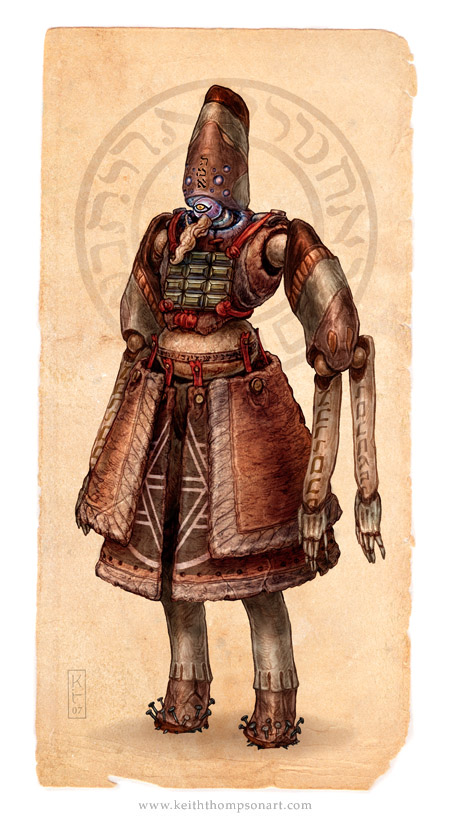
(C) Golem Mech Suit:
You can imbue three of your FD into a lump of clay that a large enough compartment to fit you inside somewhat comfortably. You inscribe the Adamic word for life on it somewhere clearly visible and breath life into it. While inside the golem, you control its movements and actions as if it were your own body. The golem has its own HP, and any damage it takes is deducted from its HP first. while you are not riding the golem mech suit it can act in the same way a common golem would. You cannot retrieve your FD until the Golem is destroyed or you dismiss it as an action. Your FD returns to your faith pool the next day.
By default a Golem Mech Suit has 3d8 hp, has a AC of 14, a DR of 4, speed of 25' and deals 1d10 damage with range 5'.

Sort of like this in terms of size but made of clay. doesn't necessarily have to be bipedal either.
(C) Golem Mastery:
Your control over your golems is absolute. Your golems will never go rogue and will always follow your commands to the best of their ability.
(D) Animate Sentient Golem:
You can imbue three of your FD into a lump of clay sculpted into the shape of a person. You inscribe the Adamic word for life on it somewhere clearly visible and breath true life into it. This Golem can think, learn, feel and act independently, though they are still utterly devoted to you. They can range in size from a human man to an ogre. You cannot retrieve your FD until the Golem is destroyed or you cruelly dismiss it as an action, though as the golem is sentient this would be an act of cold blooded murder. Your FD returns to your faith pool the next day.
By default a Sentient Golem has 3d8 hp, has a AC of 14, a DR of 4, speed of 25' and deals 1d10 damage with range 5'.
(D) Animate Colossal Golem:
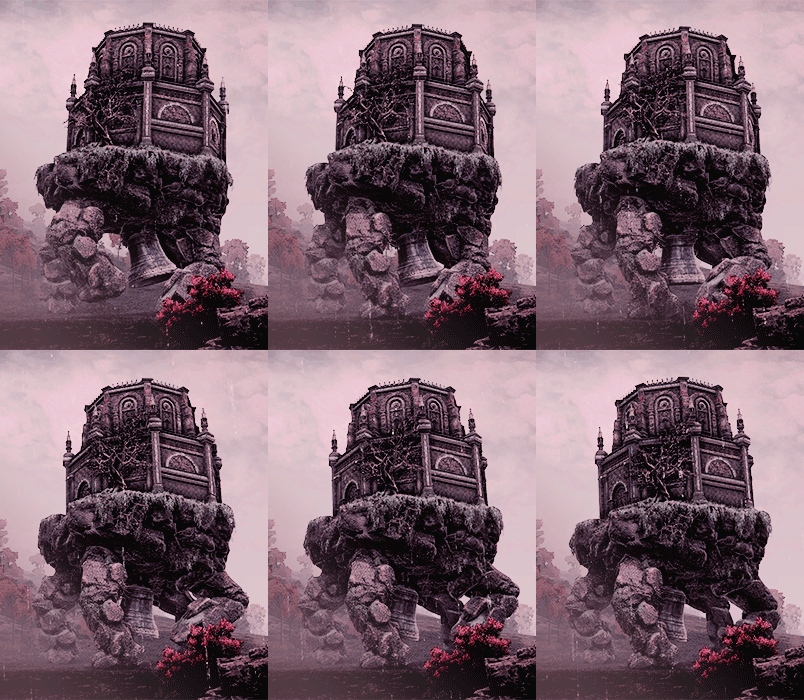
You can imbue all four of your FD into a single immense structure sculpted entirely of clay. Getting your hands on so much clay and sculpting it in a way that is structurally integral will be a truly expensive, laborious and time consuming task, but at the end of it you will have a mobile cathedral that stomps on things you tell it to. You cannot retrieve your FD until the Golem is destroyed or you dismiss it as an action. Your FD returns to your faith pool the next day.
By default a Colossal Golem has 150 hp, no AC you literally can't miss, a DR of 25, speed of 30' and deals 8d10 damage with range 0' as it deals damage by stepping on people
Miracles:
1. Heal:
R: touch
T: an injured person
D: one action
One creature is healed [sum]+[dice] HP. For each [dice] used to cast this spell, you may divide the total restored HP among up to that many creatures.
2. Bless
R: Touch
T: A person
D: [sum] minutes
For the
duration of the spell, target people add [dice] to every d20 they roll.
Characters have advantage on saves against poisons or diseases from
blessed rations.
3. Translate writing:
R: legible reading distance
T: Writting in a language you cannot read.
D: 1 hour
[sum] paragraphs of a text you cannot read are translated into Adamic, the letters appear as gold light suspended in the air.
4. Message:
R: [dice] *5 miles
T: A person you know the name of
D: one action
This spell allows you to send a message of [sum] words or fewer to a person you know. You can choose to have this happen immediately or at some point within the next 24 hours. If the target is asleep, you can choose to have the message delivered by an angel in their dream, or normally when they awake.
5. Water from the rock:
R: touch
T: A fist sized rock
D: 1 minute
You cause a rock to emit [sum] litres of holy water then crumble to sand.
6 Quicksand:
R: 60'
T: [dice]*10' square 10' deep
D: one action
You point at the ground and it become loose, ready to welcome any who enter into its smothering embrace. A creature who enters this space or ends their turn there must make a strength save or sink to their waste and become restrained, they may make a strength save at the beginning of their turn to escape if they don't succeed they sink up to their armpits and must make a hard strength save at the beginning of their next turn to drag themselves up to waste height again, if they fail they sink under completely and cannot make any more saves, someone else must rescue them or they will suffocate.
7 wall of earth:
R: 50'
T: A line up to [dice]*10' long
D: one action
You create a wall of earth up to [dice]*10' long and [dice]+10' high. The wall can be any shape, as long as it is one continuous path along the ground. Any creatures in the path of the wall as it is created must save. On a failed save, they are launched [the height of the wall]+10' into the air and take fall damage as normal. On a success they take [dice]+1d6 damage as they are merely thrown horizontally.
The wall has [sum]*2 HP and takes no damage from sharp damage, half damage from bludgeoning damage and no damage from anything that could not harm a large rock. The wall is permanent until destroyed.
8 Hallow:
R: 60'
T: 60' circle, centered on caster
D: variable
You bless the area within 60' of you. for one [dice] it lasts a day, for two [dice] it lasts a month, for three [dice] it lasts a year and for four [dice] it is permanent. Outsiders, Spirits, Ghosts and other purely Spiritual creatures cannot enter the area unless you grant them explicit permission. This makes the creation of Undead impossible within the hallowed area, unless the caster should permit it.
For each [dice] used beyond 1, select one of the options below:
- Designate a type of creature, belonging to a race, class or other specific group. Those creatures must make a morale check to enter or remain within the hallowed area.
- Designate a type of creature, belonging to a race, class or other specific group. Those creatures cannot be frightened or charmed while within the hallowed area and automatically pass all morale checks.
- Designate a type of creature, belonging to a race, class or other specific group. Those creatures take +[dice] extra damage from an elemental source of your choosing (fire, ice, etc).
- Designate a type of creature, belonging to a race, class or other specific group. Those creatures take -[dice] less daamge from an elemental source of your choosing (fire, ice, etc).
- Portals or teleportation is impossible inside the hallowed area.
- No sound that you do not wish to be heard can be heard within the hallowed area.
- You have perfect knowledge of the location of all objects and creatures within the hallowed area, as long as you are within it yourself. This gives you +4 to all attack rolls and saving throws.
- As long as you are within the hallowed area, it is illuminated by natural sunlight, unless you wish otherwise.
- All creatures within the hallowed area gain the ability to speak a language of your choosing as long as they are within the hallowed area.
Rogue Golems:
A rogue Golem is one you have lost control
of, it still has your FD locked up inside it, but it can no longer be
dismissed, it must be rendered inert by force if you want your FD back.
when a Golem goes rogue there is a 25% chance it will become hostile to
everyone, 25% chance it will become hostile to all adherents of its
creators religion (it can sense their faith), a 25% chance it becomes
hostile to its creator alone, and a 25% chance it becomes neutral only
harming those who would harm it.
The following actions have a 10% chance of causing a Golem to go rogue.
- Issuing it a command that violates its creators religion.
- Issuing orders that will likely result in its destruction.
- Issuing orders that might lead to it suffering harm for the first time.
- If it is attacked with a miracle or some other holy source of harm.
- When it kills a person for the first time.
Inspiration:
https://as-they-must.blogspot.com/2019/10/blessed-of-gd-class-cleric.html
https://www.remixesandrevelations.com/2019/02/glog-ifying-fifth-edition-spells-d.html
https://nuclearharuspex.blogspot.com/2019/03/the-golemist-glog-class.html
https://goblinpunch.blogspot.com/2019/04/the-cleric.html
Thursday, July 6, 2023
Race/Species of The setting.
There are no humans in my setting although all of the species/ races look mostly human with a few notable differences. similarly all the animals are different from those in the real world though that is another matter entirely.
Rephaite:
The Rephaite have semi-metallic bronze skin that is slightly reflective. Their eyes come in dichromatic shades of blue and brown. Typically, Rephaite individuals have brown or black hair that complements their distinctive skin tone.
Once per day you can reflexively tense your skin to harden it like metal reducing damage from a physical attack by half, this is incredibly uncomfortable to do and leaves you feeling stiff like your skin is arthritic for a week.
Kapre:
Tall and limber, the Kapre are a race with jet black skin adorned with delicate pinkish-white stripes, reminiscent of a tiger's markings, and ridged blue cheeks like a mandrill. They have purple and white eyes with a cratered appearance reminiscent of the moon. Their long and pointed ears poke out from heads of stark white hair. Their forearms also spot strips of hair that follow their ulna bones. Kapre age half as fast as other peoples and can expect to live for two centuries provided nothing kills them first.
Your long life came with an equally long childhood, during which you learned a great deal more than the shorter lived people. begin with two additional skills and two additional skill slots for them (5 starter skills instead of 3).
Dvergr:
The Dvergr possess short and stocky frames, and pallid grub like skin. Their beady eyes are brown or orange. Their distinctive features include long earlobes and insinuative red hair that they typically grow long to insulate them in their frigid ancestral lands. Notably, they have teeth that grow perpetually, much like those of a beaver as well as internal teeth lining their wide throats. Their noses have flesh protuberances around the nostrils that are incredibly sensitive to vibrations.
You can tunnel through loose earth by eating it and expelling it out the other end with some force (this is liable to put a hole in pants without a bum flap). In addition if you press your face against a surface you can feel any nearby vibrations with your nose protuberances.
Bauk:
The Bauk have mottled bluish-grey skin and peach coloured bellies. Their distinctive tusks, reminiscent of a boar, continue to grow over their life time. their white irises stand out against their blood red sclera and are framed by equally fiery red hair. their nostrils are vertical slits that run halfway up either side of their nose.
Your people have iron stomachs, If you go scavenging you have 75% of finding something only a Bauk could eat in addition to any other food you find, this will feed you for a day.
Kaibyo:
The Kaibyo have the shortest stature of any peoples. They have peach skin. Their pointed ears and emerald green eyes are remarkably catlike, and are framed by wavy black hair. This hair extends to the backs of their padded hands and feet. They are also possessed of bifurcated tails, which sway in response to their mood.
Naga:
Scaly green skin characterizes the Naga. Their reptilian eyes are bright blue. They have Frilled membranous ears and jaws which can unhinge like those of a snake. Naga have Antlers like those of Chinese dragons protrude from heads of golden or platinum blonde hair, that harken back to their draconic heritage.
You have an exceptional lung capacity you can hold your breath for an half an hour while doing strenuous activities, 3 hours while in a meditative state.
Strigoi:
Strigoi have ash-grey skin except on their bellies where it is transparent giving full view of their internal anatomy. Their eyes are unblinking black orbs. Their osseous noses jut needle like from their faces, hard with bone instead of cartilage. They sport curly white hair, which they often style elaborately.
You can heal 1d4 health a day by drinking a litre of blood, it doesn't have to be people blood but it does need to be fresh.
Oni:
Oni possess brilliant red skin and yellow eyes with black sclera. their hair ranges from white to grey to black. Oni are possed of black horns, teeth and tusks like those of a warthog. While ideally not visible all of the bones in an Oni's body are stark black.
Your people are exceptional mountaineers, you can grip and climb near shear surfaces and never suffer from altitude sickness.
Cynocephali:
The cynocephali possess coffee coloured skin, black lips and eyelids. Their eyes are briliant gold. Their hair is black and covers their long and pointed ears reminiscent of a rabbit, and their long bushy tails. the tips of their ears and tails have a much lighter brown colouration. The cynocephali possess protractile jaws, capable of lurching outward to form a snout due to their upper mandible being a separate bone to the rest of their skull.
You have a sense of smell to rival a bloodhound, while this isn't always pleasant it is useful. Additionally when you protract your jaws into a snout you can make bite attacks that deal 1d4+strength mod damage.
Subscribe to:
Posts (Atom)